|
Map & Tree based Navigation
Knowledge Map
Much of
Now
& Then's
intelligence comes from its extraction and
mapping of your knowledge, your vocabulary, and its you-centric meta-knowledge
(knowledge about knowledge) into a multi-dimensional matrix or Knowledge Map.
Now
& Then
uses this knowledge about your world and your use of lan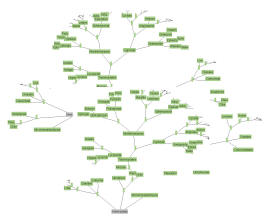 guage to make
"good guesses" regarding the multiple ways and extent each piece journal
information is associated and related to every other piece of journal
information. guage to make
"good guesses" regarding the multiple ways and extent each piece journal
information is associated and related to every other piece of journal
information.
The Knowledge Map tracks the ever changing associations and relationships
between subject matter, topics, co-occurrences, categories, terms, and user
customization, feedback, and rules. To further enhance its retrieval accuracy,
Now
& Then
parses the content and context of every Query using Bayesian
statistics and the
Intelligent
Calendar.
Because the Knowledge Map is an multi-dimensional rather than hierarchical
representation of your journal's knowledge it cannot be visualized
and
navigated like a flat map, ontology, or Web-like network. While we can visualize
in only three dimensions, the Knowledge Map's topology may include
thousands of dimensions.
It uses "knowledge agents" to automatically recognize and statistically classify
categories, topics, and other thematic clusters and ontologies. These are
represented in n-dimensions according to their relative, context dependent,
"one-to-many" and "many-to one" associations.
Knowledge Tree
The
Knowledge Tree is a three dimensional
representation of the multi-dimensional Knowledge Map. It is a convenient and
surprisingly agile tool for navigating your journal's information.
You use the Knowledge Tree to visually and flexibly browse and review your
journal information while keeping a sense of (contextual) place and direction.
Your Knowledge Tree is virtual rather than static or hierarchal. It graphically
represents the query-dependent associations and connections among the
information stored in your journal.
The content and context of your Queries determine your "current focus" and your
initial Knowledge Tree "branch" or "point of entry". Branches nearest
your current focus reference journal information that most closely satisfies your
Query. More distant branches represent journal information that is
contextually less related to your last Query.
Starting from your entry point or current focus you can navigate through the
Knowledge Tree from branch to branch―changing your
current focus with each move. You can follow your interests and ideas from branch to branch by pointing
and clicking, or by modifying your original Query. Using the visual tree and an
evolving Query, you can nudge your search in new directions and follow your interest wherever your muse takes you.
Use structure and specificity in your Query parameters, such as with Topic and
Category
to limit ambiguity in the (tree) branches around your
Query's current focus.
Often, your tree will pull together "far flung" journal
information. Tree branches, from trunks to twigs, represent a "virtual"
collection of journal information that satisfies your Query. Any virtual
branch might include combinations of single memoirs, timelines populated according to a
Topic,
a calendar series, virtual narrative spanning the entirety of your journal, a
Web page, a tracking table, etc.
In case you want to backtrack, your navigation history is always available―listed on a
dropdown menu. Another dropdown menu provides navigation suggestions based on
Now
& Then's
understanding of your interests, browsing trends, and its all-knowing
perspective of your journal's knowledge, associations, categories, terms, and
rules.
home
|



