|
Machine Learning
You might think of
Now
& Then
as a "cognitive
computer" that learns and adapts by monitoring y our
queries, the changing content
and context of your journal, and your unique journal use
patterns. It also learns from feedback about your world, your life experiences,
through "active" teaching, and your rating of query relevance. You jump start its education by: our
queries, the changing content
and context of your journal, and your unique journal use
patterns. It also learns from feedback about your world, your life experiences,
through "active" teaching, and your rating of query relevance. You jump start its education by:
-
"initializing"
its understanding of how you use language using a
"term attribute scaling" exercise
where you "rate" (from 1 to 10) attributes of words in your
vocabulary,
-
"constructing" rules using the
RuleBuilder, and
-
"populating" user-specific ontologies
(for example, places: USA―California―San Francisco area―Muir Woods)
Two exercises establish
Now
& Then's
initial understanding of your worldview.
1. Attribute analysis
Using the Attribute Scaling Utility you initialize, personalize, and update your journal's
understanding about how you personally use language. The Utility prompts you to rank, or scale, the attribute-specific
relationship between many sets of two words.
An example of an attribute scaling is to rate, between 1 to 10,
how closely you associate the word "Redwood City" with each of the terms: with
"work" "home" "client" "Florida" "Golden Gate" "pizza" "mountains"
In Attribute Scaling analysis, the degree in which terms are associated is
expressed using a variance and correlation matrix. The matrix is actually a
multi-dimensional mathematical representation of a "space"
or map of the many-to-many relationships of the terms you use in your journal.
The coordinates for the terms and phrases used in your
 journal
are mapped
into hundreds of dimensions. Your queries are filtered through this multi-dimensional "map" of your
"attribute-scaled" vocabulary to chart the similarities or dissimilarities (distances)
between terms and phrases―and to detect meaningful underlying language
relationships and structures. journal
are mapped
into hundreds of dimensions. Your queries are filtered through this multi-dimensional "map" of your
"attribute-scaled" vocabulary to chart the similarities or dissimilarities (distances)
between terms and phrases―and to detect meaningful underlying language
relationships and structures.
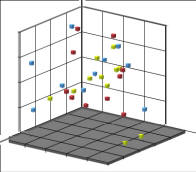
To simplify the concept, reduce "multi-dimensions" down to just three―with
the coordinates for the words "dolphin" "Florida" and "football"
plotted on X, Y, Z axis. Their relationships are defined by their coordinates in three―rather
than N dimensions.
3 dimensions Florida -
dolphin- football
2. Worldview Ontologies
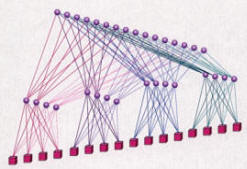
Similarly, you provide the initial values of "knowledge maps" or ontologies that
capture the relative relationships and manage descriptions about the people,
places, things, and ideas described by you in your journal―this is knowledge
about knowledge, or the meta-knowledge of your worldview.
Using
Now
& Then's
ontology entry utility, you can add more information to your ontologies at any time. For example, you might create groups
called "neighbors", "work associates", or "best friends" and then add the names
and / or nicknames of individuals. Or, you might create "places" concept groups
such as "local", "regional", or "business trips" and populate each with
the "place"
names that you reference in your journal. You can also manage
your ontologies to add detail and clarify ambiguities―for example, "for the
years 1998 through
2010, "regional" is the San Francisco area. For the years 1980 -1984
"regional" is metro Santa
Barbara.
home
|



