|
Pad Journaling
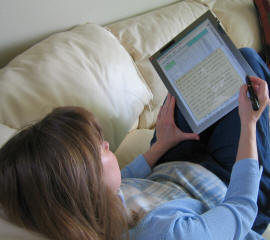 The
design specification for Retrospective Software's new
journal was that it had to pass the "easy chair test". People want to use their
journal at times when they are most reflective ― for most of us this is not when
we are sitting in front of our desk PC. Most of us prefer to update and review our
journal when we can concentrate, undisturbed―sitting in an easy chair, or in
bed, reflecting on the past day before drifting off to sleep. The
design specification for Retrospective Software's new
journal was that it had to pass the "easy chair test". People want to use their
journal at times when they are most reflective ― for most of us this is not when
we are sitting in front of our desk PC. Most of us prefer to update and review our
journal when we can concentrate, undisturbed―sitting in an easy chair, or in
bed, reflecting on the past day before drifting off to sleep.
Now
& Then
was designed with the understanding that it needed to mimic the
experience people have with their traditional cloth or leather bound journal―including writing and searching while in a reflective setting. As with the
introduction of most new media, we recognized that the medium is the message―we needed users to feel that their new journal was a familiar friend even though
it was running on a pad computer. If our users could enter and review journal
entries exactly as they would using their traditional journals they could
essentially "forget" that they were using a computer and could learn to use the
power and capabilities of
Now
& Then
at their own pace.
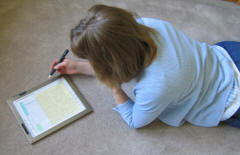 Handwriting recognition and pad computing were technologies
that had to
sufficiently mature to make a revolutionary journal like
Now
& Then
a reality. Pad computers and accurate handwriting recognition
now provide the "look and feel" of a paper personal journal. Pad computers also have the processing power needed for
Now
& Then's
context-aware search, information mining, and presentation software―applications that not long ago
required the processing power of mainframe computers. Handwriting recognition and pad computing were technologies
that had to
sufficiently mature to make a revolutionary journal like
Now
& Then
a reality. Pad computers and accurate handwriting recognition
now provide the "look and feel" of a paper personal journal. Pad computers also have the processing power needed for
Now
& Then's
context-aware search, information mining, and presentation software―applications that not long ago
required the processing power of mainframe computers.
Trainable handwriting and speech recognition was also a key requirement to
support every user preference for journal entries, navigation, search queries, and presentation commands.
In the future Retrospective Software may support journaling devices based on
emerging technologies such as digital pen, electronic paper, and electronic ink.
home
|



