|
Memoir organization
& structure (continued)
Self-Organizing Memoirs
In response to Queries and
Browsing,
Now
& Then
automatically organizes and
visually presents retrieved information for maximum comprehension.
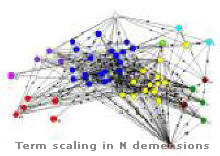
Indexes guide the (self) organization of Query results.
All journal entries are periodically re-indexed based on:
- their
semantic and contextual relationships,
- your Query content, and
- the system's analogical
understanding of your information domain.
The indexes are the mathematical maps of your semantic (language) and domain (knowledge)
journal information.
Multi-dimensional
word attribute matrices quantify
the degree of association, identify co-occurrences, and determine
which groups, affiliations and clusters of information are "native"
and which are "system
assembled".
This enables the identification, discovery, and ranking of relevant but hidden,
or forgotten knowledge―particularly information that would be inaccessible
using superficial methods such as keyword, proximity, and Boolean-based queries.
The attributes of the retrieved
information determine how it will
be organized and presented―using combinations of: narrative, timelines, graphics, images, charts, parent-child
outlines, and association-links.
User Organized
Memoirs
In addition to self-organizing memoirs, you can organize and
structure your "native" journal information at the time of entry or later―should a
structure suggests itself.
At any time you can create your own
Virtual
Views
using your selections of narrative, table / grid, hierarchical, parent &
child, and linked structures.
Tags, Highlights, and Assignments are
useful tools for gathering, grouping, and organizing your information. Of course,
assignments to Categories, Topics, and Collections can give structure to disparate information. User-built rules can also automatically
classify and organize new (and existing) information.
see also: The Intelligent Journal . . . Self-Organizing Memoirs
home
|



